
The continental Pan-African Parliament, operating under the African Union, held its seventh session from May 5 to May 7 at its seat in Midrand, South Africa, where it elected its President and Vice-Presidents. During this three-day session, the Ethiopian Member of the House of Peoples’ Representatives, Honorable Dr. Ashebir Woldegiorgis, was elected as the First Vice-President among the elected Vice-Presidents.
In this leadership role, he will serve within the institution for the next three years, representing the East African region. This election of leaders has once again ignited discussions regarding the Pan-African Parliament’s establishment and institutional structure, its frictions with the African Union, and the internal and external pressures for autonomy. Furthermore, this review chooses to explore the Malabo Protocol; a document Ethiopia has yet to ratify, which is hoped to give the institution teeth. We will also raise points based on researched articles and arguments regarding whether this parliamentary institution has lessons to draw from its counterpart, the European Parliament.
The Representative’s Third Term
Honorable Dr. Ashebir Woldegiorgis, a member of the Ethiopian House of Peoples’ Representatives, has been elected as the First Vice-President of the Pan-African Parliament. It is recalled that Dr. Ashebir has previously served the Parliament in three different capacities, including as Second Vice-President and Acting President. The Pan-African Parliament, an organ of the African Union, announced the leaders elected to lead the institution for the next three years during its Seventh Legislative Session’s extraordinary meeting held from May 5 to May 7 at its headquarters in Midrand, South Africa:
President (North Africa): Honorable Fateh Boutbig (Algeria),
1st Vice-President (East Africa): Honorable Dr. Ashebir Woldegiorgis Gayo (Ethiopia),
2nd Vice-President (West Africa): Honorable Dr. Zanetor Agyeman-Rawlings (Ghana),
3rd Vice-President (Central Africa): Honorable Djidda Mamar Mahamat (Chad) and,
4th Vice-President (Southern Africa): Honorable Dr. Arlete Borges (Angola).
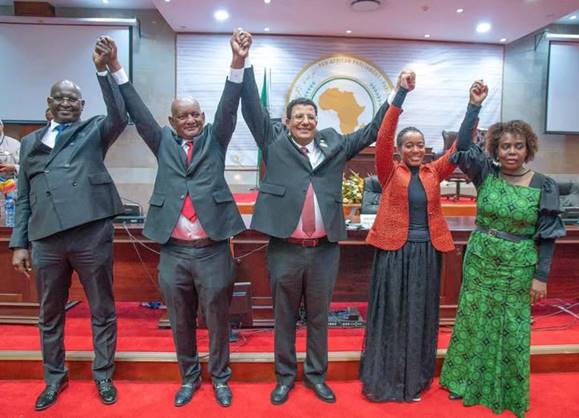
The election was conducted in accordance with the African Union Executive Council Decisions 1288 (XLVI) and 1663 (XLVII) and was executed based on the additional decision adopted on March 27, 2026, and Rule 29 of the Pan-African Parliament’s Rules of Procedure. The process was overseen by the Chairperson of the Commission, Mahmoud Ali Youssouf, representing the Chairperson of the African Union, and was supported by a high-level delegation to ensure the election’s transparency, credibility, and adherence to the legal and institutional frameworks of the African Union.
The President of the Pan-African Parliament, Fateh Boutbig, stated, “The successful conclusion of this election is a major milestone in the continuous institutional renewal of the Pan-African Parliament, strengthening its commitment to democratic governance, accountability, and the rule of law.” The President added that the election reflects the African Union’s principle of regional rotation, ensuring that all five regions of the continent are equitably represented.
The newly elected leadership, traditionally referred to within the institution as the ‘Bureau,’ will serve for a term of three years. It is tasked with providing strategic direction and leadership to the Parliament in alignment with its mandate to ensure the full participation of African peoples and the diaspora in the continent’s development and economic integration.
According to institutional information, as the primary leadership and administrative body of the Parliament, the Bureau is responsible for directing the overall administration of the institution and its subsidiary organs, as well as ensuring that its structures operate effectively in compliance with the African Union’s financial rules and procedures.
Following that session, the Women’s Caucus of the Pan-African Parliament also elected a new Bureau leadership as part of the renewal of the seventh legislature’s leadership structure. The election followed the principle of rotation, and the new leadership, headed by Honorable Rahab Mukami Wachira of Kenya, is composed as follows:
President (Eastern Caucus): Hon. Rahab Mukami Wachira (Kenya)
1st Vice President (Southern Africa): Hon. Aisha Adams (Malawi),
2nd Vice President (West Africa): Hon. Fatoumata Njai (The Gambia),
3rd Vice President (North Africa): Hon. Awatef Cheniti (Tunisia) and,
4th Vice President (Central Africa): Hon. Leocadie Ndacayizaba (Burundi).
Through this process, the Pan-African Parliament has reaffirmed its commitment to advancing the vision of Agenda 2063, also known as “The Africa We Want,” and to strengthening its role as a responsive, transparent, and citizen-centered institution within the African Union framework. The election of the new Bureau is also expected to pave the way for the renewal of other parliamentary leadership structures, such as the Bureaus of Permanent Committees and Regional Caucuses.
Background at a Glance
The 1991 Abuja Treaty stipulated the establishment of the Pan-African Parliament (PAP) to ensure the full participation of African peoples in the continent’s economic development and integration. This concept was further reinforced under Article 17 of the Constitutive Act of the African Union. Building on this background, the Protocol to the Treaty Establishing the African Economic Community relating to the Pan-African Parliament was adopted on March 2, 2001, in Sirte, Libya. Consequently, the Pan-African Parliament was inaugurated as one of the organs of the African Union in March 2004 in Addis Ababa.
The Parliament’s first ordinary session was held in March 2005 in South Africa, which serves as the permanent seat of the institution. The Pan-African Parliament conducts two ordinary sessions annually, preceded by various committee meetings that deliberate on the Parliament’s agendas.
According to institutional documents, the Pan-African Parliament was established with the vision of creating a continental platform where African parliamentarians can extensively participate in discussions and decision-making processes regarding the continent’s problems and challenges. To ensure the representation of the continent’s diverse peoples, Article 4 mandates that out of the five members sent by national parliaments to the Pan-African Parliament, two must be from opposition parties.
Members of the Pan-African Parliament serve a five-year term. During its first tenure from March 2005 to 2009, the Parliament operated with consultative and advisory powers. This involved debating continental political and developmental issues and submitting recommendations to stakeholders such as African Union organs, Regional Economic Communities (RECs), and AU member states. However, it is expected that during and after its second tenure, the Parliament will transition into a legislative body with the authority to enact continental laws. In this regard, revising the Protocol to the Pan-African Parliament has become necessary to facilitate this transition.
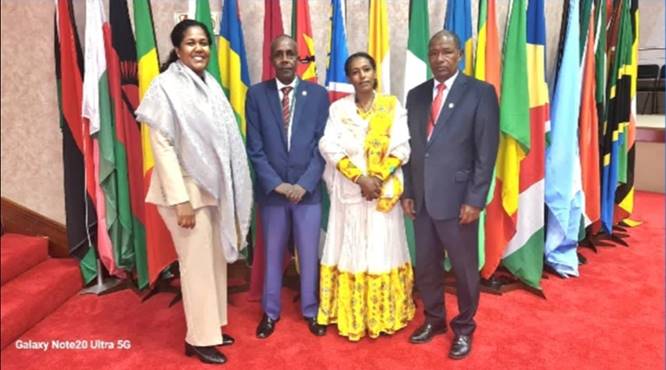
During the opening of the 3rd Ordinary Session of the 6th Pan-African Parliament in Midrand, South Africa, in June 2024 (Sene 2016 EC), the Ethiopian members of parliament present were (from left to right): Hon. Lomi Bedo, Hon. Ashne Astie, Hon. Meseret Ayele, and Hon. Dr. Aweke Hamzaye.
In its current institutional form, the Pan-African Parliament functions as a consultative body that conducts investigations, holds deliberations, and provides recommendations and decision support on continental issues. Primarily, its first tenure is expected to be a period during which the Parliament establishes the procedural rules and administrative structures necessary to perform its functions fully. In this regard, the Parliament adopted its Rules of Procedure in 2004, which detail the institution’s character and structure. Additionally, the Parliament has drafted and approved a strategic action plan to guide its activities until the end of its first tenure.
Like other organs of the African Union, the budget of the Pan-African Parliament is covered by the regular contributions made by member states to the African Union. Since the funds allocated from the African Union budget are often insufficient, the Parliament has established a Trust Fund to mobilize financial support from donor agencies. Furthermore, it is recalled that the African Union Assembly of Heads of State and Government decided that member states should cover the financial expenses of their members participating in the Parliament’s sessions.
Powers and Mandate of the Parliament
The functions and powers of the Pan-African Parliament are specifically defined under Article 11 of the Protocol to the Treaty Establishing the African Economic Community relating to the Pan-African Parliament. Accordingly, mentioning some of the key powers and functions is essential to gaining a complete picture of the institution. Among the primary ones are:-
- Investigation and Deliberation: – To investigate, deliberate on, or advise on any matter, either on its own initiative or at the request of the Assembly or other policy organs; furthermore, to submit such recommendations as it deems appropriate on issues relating to the promotion of human rights, the strengthening of democratic institutions and culture, good governance, and the rule of law.
- Budgetary Consultation: – To deliberate on its own budget as well as the overall budget of the African Union and to provide recommendations before the budget is approved by the AU Assembly of Heads of State and Government.
- Harmonization of Laws: – To work toward the harmonization or coordination of the laws of Member States.
- Advancing Integration: – To propose recommendations that contribute to the achievement of the objectives of the African Union; additionally, to identify challenges and suggest solutions regarding the process of African integration.
Regarding its structure, as cited in the institution’s founding documents, every African Union member state that has ratified the Protocol is entitled to be represented by five members of parliament. These members are elected from their respective national parliaments and are expected to attend the sessions of the Pan-African Parliament.
The President serves as the chairperson of the Pan-African Parliament and is elected from among the members during the first session of each term. The primary role of the President is to facilitate deliberations during sessions, serve as the political leader of the Parliament, and oversee the institutional activities of the continental parliament. In this capacity, the President is assisted by four Vice-Presidents representing the other four regions of the continent.
The Election and Its Institutional Implications
The debates surrounding the Pan-African Parliament (PAP) were clearly reflected in the election held last month. According to analysts, the controversy that reportedly occurred during the recent election has raised deep questions regarding how the balance between oversight roles and administrative authority should be maintained within the African Union system. The widespread dispute witnessed during that election is being viewed by legislators and analysts from a broader institutional perspective, indicating fundamental structural questions within the African Union’s governance framework. While recent discussions have focused on the election process and the interpretation of legal documents, some observers argue that the controversy reflects a more fundamental issue; the relationship between the Pan-African Parliament’s oversight authority and its administrative dependence on the African Union Commission.
The Controversial Article 11
It is well known that the Pan-African Parliament was established as the legislative organ of the Union to represent the peoples of Africa, ensure democratic governance and accountability, and perform oversight functions regarding the African Union’s policies, programs, and institutions.
In theory, the Parliament plays a central role in ensuring that the Union’s activities are carefully scrutinized and aligned with broader integration and governance goals. However, in practice, observers point out that the Parliament’s legislative authority remains limited, with its powers primarily based on advisory and recommendatory functions. Although the Parliament engages in debates, adopts resolutions, and submits recommendations, it is often noted that its capacity to practically enforce oversight outcomes is restricted within the current institutional framework.
The provision in Article 11 of the Parliament’s Protocol, which designates it as an “advisory and consultative” body, is frequently cited as a justification for limiting the Parliament’s authority. However, institutional scholars argue that a deeper examination of the article reveals that this provision does not imply subordination, but rather represents a gradual, phased institutional devolution of power.
Advocates of this view contend that this article does not place the Parliament under the operational control of the African Union Commission or the legal directorate; instead, it defines the temporary functional role of the institution until such time as the AU Assembly grants it full legislative powers. The critical distinction lies here: Article 11 limits the type of power the Parliament exercises (consultative rather than legislative), but it does not transfer that power to another entity, nor does it authorize an external body to direct how those consultative functions should be performed. In other words, the core argument is that a lack of legislative authority does not equate to administrative subordination.
In practice, however, this distinction has become increasingly blurred. Specifically, the growing reliance on legal interpretations and administrative directives issued by the Commission’s Office of the Legal Counsel has effectively transformed that temporary limitation of power into administrative dependency. This is precisely where the friction lies: while Article 11 was intended as a temporary functional constraint, critics argue it is now being applied as a permanent institutional hierarchy.
This struggle is further intensified by the Parliament’s budgetary and administrative ties within the African Union structures. While Article 11 allows the Parliament to deliberate and offer recommendations on the budget, the final financial approval remains in the hands of an external body. Similarly, while the Parliament can summon officials and request documents, it lacks binding oversight authority. These informal practices have created a system where the Parliament is expected to provide continental oversight and influence policy, while simultaneously remaining materially dependent on the very structures it is meant to oversee.
However, the legal framework does not permit the Commission to hold an expansive supervisory role. Neither in Article 11 nor in any other section of the Protocol is the Commission granted the authority to direct parliamentary proceedings, determine institutional outcomes, or suspend the functional mandate of the Parliament. On the contrary, the Protocol preserves institutional autonomy within functional limits by empowering the Parliament to adopt its own Rules of Procedure and elect its own leadership.
Consequently, current debates regarding rule compliance, interpretations of tenures, and election timelines expose a profound structural question: Is Article 11 serving as a bridge to legislative elevation, or has it become a tool for institutional containment and obstruction? The issue remains suspended between these two polarized interpretations.
If the latter; institutional containment, prevails, the risk is not merely procedural but systemic. A parliament restricted to purely consultative functions and subjected to external directives risks losing its credibility and institutional identity, reducing it from an emerging legislative body to a mere advisory office. Conversely, an accurate reading of Article 11 based on the broader framework of the Protocol supports a parliament that possesses independent advisory authority, gradually transitioning toward full legislative competence.
Similarly, the Pan-African Parliament operates within an administrative framework closely intertwined with the African Union Commission. In practice, the institution’s operations are heavily dependent on budget allocations approved through African Union structures, administrative support provided by the Commission, legal interpretations issued by the Office of the Legal Counsel, and institutional systems based at the Union’s headquarters. The financial dimension of this relationship is explicitly stipulated under Article 15 of the Parliament’s Protocol, which integrates the Parliament’s annual budget into the regular budget of the African Union.
While the Parliament is responsible for preparing its budget in accordance with the Union’s financial rules, final approval remains in the hands of the governments and the Assembly of Heads of State and Government. Combined, these practices have led some analysts to observe that while the Parliament is mandated to exercise oversight over African Union institutions, it remains functionally and financially dependent on the very structures it is meant to oversee. This creates an enduring institutional friction, as the body tasked with oversight must operate within a framework designed by the institutions it is supposed to scrutinize.
Against this background, the controversy surrounding last month’s election carries a broader significance. Observers note that some members of parliament argue that the events regarding the election schedule, the revision of internal rules, and the role of the Office of the Legal Counsel demonstrate how external administrative and legal processes can influence the internal governance of the Parliament. In particular, the ongoing revision of the Parliament’s Rules of Procedure has drawn attention to how institutional realignment processes might involve entities outside the Parliament, raising questions about how its internal independence is being exercised in practice. While these processes are presented as efforts to ensure alignment with the Parliament’s Protocol and the Union’s legal instruments, some legislators state that it has created the perception that the Parliament’s internal operations are being shaped by the Union’s broader administrative framework.
This discussion is also said to have brought renewed focus to the fundamental commitments of the African Union. The preamble of the Constitutive Act of the African Union mentions among the responsibilities of member states: “Determined to take all necessary measures to strengthen our common institutions and provide them with the necessary powers and resources to enable them to discharge their respective mandates effectively.” According to some analysts, the current debate highlights the ongoing challenge of translating this commitment into practice. While African Union institutions have shown significant growth over the years, many still ask: how can it be ensured that organs like the Pan-African Parliament receive the necessary power, resources, and operational independence to fulfill their mandates effectively?
For many observers, the issues raised by the dispute over the Bureau election carry a deeper meaning beyond the question of leadership transition. Rather, they point to a broader governance question within the African Union system: how should the Union balance the administrative coordination provided through the AU Commission with the independence that institutions like the Pan-African Parliament ought to possess? This question is not merely for the present moment but is reflected in the ongoing evolutionary process of African Union institutions as they define their respective roles and relationships within an increasingly complex governance structure.
Diplomats, legal experts, and institutional governance analysts state that how this balance is maintained will have significant implications not only for the Pan-African Parliament but for the overall functioning of the African Union. Many observers emphasize that for effective oversight to exist, institutions must have the authority to investigate and the capacity to operate impartially; at the same time, they must maintain their coordination within the Union’s general administrative framework.
The Malabo Call
What exactly is this Malabo Protocol, which fewer than thirty African countries; including our country, Ethiopia, have yet to ratify? What is it, and what is it not? What has held the nations like Ethiopia from signing the document? Briefly examining these questions provides a sufficient perspective to understand the debates surrounding the institution.
In June 2014, the African Union Assembly adopted the protocol known as the Malabo Protocol, which amends the 2001 founding instrument that established the Pan-African Parliament. Although Article 25 of the 2001 Protocol planned for institutional reviews every five and ten years to ensure Parliament’s goals and vision aligned with the continent’s evolving needs, the implementation of the Malabo Protocol has been delayed due to a lack of sufficient ratification from member states. Of the 28 countries required for the document to officially enter into force, only 15 have submitted their instruments of ratification to date. Consequently, new provisions regarding membership criteria, limits of authority, and other institutional relationships remain unimplemented.
According to the Protocol’s provisions, each member state sends five representatives to the Parliament, at least two of whom must be women; if this gender composition is not maintained, the delegation will not be eligible for accreditation. While representatives are elected by their respective national parliaments, the unratified Malabo Protocol mandates that those elected must not be sitting members of a national parliament (or must resign if they are). Furthermore, the election must take into account the diversity of political opinions within the national parliament. The document limits members to a five-year term with the possibility of one additional re-election. It also defines the leadership structure; comprising one President and four Vice-Presidents, ensuring representation for all five African regions and gender equality for a term of two and a half years.
Regarding authority, the Protocol empowers the Parliament to draft non-binding model laws on matters authorized by the AU Assembly. Beyond this, it stipulates that the institution shall have the responsibility to deliberate on the Union’s budget, conduct fact-finding and observer missions, and examine the reports of other African Union organs.
The Protocol specifies that the responsibility for covering the salaries and allowances of members rests with their respective member states and mandates that the Parliament hold its ordinary sessions at least twice a year. Overall, analysts who have thoroughly examined the document argue that the Malabo Protocol is a consultative and collaborative legislative framework designed to facilitate continental cooperation while respecting the sovereignty of member states, reflecting the aspirations of Africans to solve their common challenges together.
Although Ethiopia is a member of the African Union and a participant in the Pan-African Parliament, it has not yet ratified the Malabo Protocol. The primary reason for this hesitation is concerns related to national sovereignty, stemming from the apprehension that the Protocol; by transforming the Pan-African Parliament from a largely advisory body into a legislative one, could limit the authority of national institutions. Additionally, there are legal and institutional doubts regarding how the Protocol aligns with domestic constitutional frameworks, as well as how its provisions would be practically implemented and enforced. Ethiopia’s position reflects a broader continental trend, as many African countries are noted to have delayed ratifying the Protocol due to similar political and structural concerns.
Since its adoption, granting limited legislative authority to the Pan-African Parliament through the Malabo Protocol has created a fear of losing national sovereignty among some African Union member states. This concern is one of the main reasons why the Protocol has failed to secure the necessary approvals from countries to enter into force for over a decade. Although most countries do not speak publicly about this matter, their concerns regarding the ceding of sovereignty are occasionally expressed. For instance, during a debate in the Ugandan Parliament, Uganda’s Deputy Attorney General stated that the delay in ratifying the Protocol was due to the need for extreme caution before signing a document that grants the Parliament power to enact laws. He urged that the status of the Parliament’s laws in relation to national laws must be carefully examined and that adequate preparation is required before ceding sovereignty. This sentiment suggests that other member states likely harbor similar concerns regarding empowering a continental parliament.
However, a closer look at the Protocol’s provisions, particularly Article 8.1 (a) and (b), reveals that these concerns may be unfounded. Rather than undermining sovereignty, the Malabo Protocol establishes a balanced framework that strengthens the Pan-African Parliament while safeguarding the independence of member states. According to Article 8.1 (a), it is the African Union Assembly that determines the specific subject areas in which the Pan-African Parliament may draft model laws. Furthermore, under Article 8.1 (b), while the Parliament can initiate legislative proposals on its own, it must obtain the approval of the Union Assembly before proceeding to implementation. This structure creates a two-tier oversight system that ensures both the initiation and direction of legislation remain entirely in the hands of member states. Moreover, the Parliament is only authorized to draft non-binding model laws. These laws serve merely as templates for harmonizing legislation across the continent and do not have direct applicability in any individual country.
For any model law to be implemented at the national level, it must pass through each country’s internal legislative process, and national parliaments retain full authority to accept, modify, or completely reject the proposal. Many observers argue that, rather than infringing upon sovereignty, this procedure is intended to strengthen legal cooperation in a manner that respects the independence of national parliaments.
Another misconception that has hindered the ratification of the Protocol is the belief that the Parliament will transform into a permanent institution enacting binding laws across the continent. However, as Article 15.2 of the Malabo Protocol clearly stipulates, the Parliament shall meet in ordinary session only twice a year, with each session lasting a maximum of one month. This provision ensures that the institution is not a permanent and supreme legislative body, but rather a supporting institution that convenes periodically as necessary.
Therefore, the argument that the Malabo Protocol should be viewed as a strategic innovation, enabling the integration of legal frameworks on transboundary issues such as trade, human rights, and public health, rather than as a threat to sovereignty carries more weight. In general, since Articles 8.1 and 15.2 ensure that the Parliament operates within the boundaries set by member states, the continental utility of the institution would be significant if influential countries such as Nigeria, Egypt, Kenya, Ethiopia and South Africa were to view the Protocol with a fresh perspective and ratify it.
Is There Anything Pan-Africanists Can Learn from the European Parliament?
Among the debates surrounding the Pan-African Parliament, perhaps the primary argument revolves around whether the institution should draw lessons from the European Parliament (EP). Do Pan-Africanists have anything to learn from their European counterparts?
The European Parliament serves as a highly advanced example of a continental legislative body from which the Pan-African Parliament can draw lessons and follow as a model. Consequently, when considering the proposal to transform the Pan-African Parliament into a legislative body, it is essential to examine the evolution of the European Parliament and the decisive steps that brought it to its current status. Through this path, the European Parliament transitioned from possessing minimal advisory powers to holding significant legislative authority in many sectors (with the exception of foreign affairs), and its necessity and relevance within the European Union’s governance structure have grown over time. There are numerous comparative lessons to be learned from this evolution, and scholarly voices strongly emphasize that any assessment or transition of the Pan-African Parliament must take these points into account.
First, it is important to note that the Pan-African Parliament is still an institution in its nascent stage. It took the European Parliament approximately 29 years (until 1987) to acquire any significant additional powers. Therefore, while much work remains to demonstrate the Pan-African Parliament’s readiness to assume legislative authority, the question arises: how realistic and practical is it to expect a transition to full legislative status in such a short period? It can be argued that during the years between its founding and the acquisition of legislative powers, the European Parliament focused on building its institutional capacity and strengthening its role.
Second, the European Parliament’s transition from an advisory to a legislative body was a gradual process that began in 1958. This process involved moving from a purely consultative role at its inception to achieving co-legislative authority. It took 21 years for members of the European Parliament to be directly elected and 41 years to reach its goal of becoming a full legislative body. Thus, a question frequently raised in literature regarding the institution is:- should the transition process of the Pan-African Parliament follow a similar gradual journey where power is devolved in stages, or not?
Thirdly, the development of the European Parliament did not occur in isolation; rather, it was linked to the broader evolution of the European Community, which transformed into the European Union through the 1992 Maastricht Treaty. The Maastricht Treaty brought significant changes to the EU’s institutional structures. The shifts that elevated the European Parliament’s power relative to other administrative bodies also necessitated structural changes in other institutions, particularly the Commission and the Council. In this regard, it is predictable that any fundamental changes to the legal framework of the Pan-African Parliament, including its Protocol, would inevitably trigger similar structural changes in other African Union administrative organs and their relationship with the Parliament.
Reflecting these changes and formally establishing the accountability of other bodies to the Parliament might necessitate amending the Constitutive Act of the African Union, which serves as the founding document. Currently, the links between the Pan-African Parliament and other AU organs are governed independently by their respective protocols. Analysts suggest that there is one significant lesson the Pan-African Parliament cannot draw from the European Parliament, which stems from the fundamental difference between the AU and the EU. The European integration process was a bottom-up approach, starting with a few countries and creating conditions for others to join. Conversely, African integration is a top-down process. All African countries are declared members of the African Union simply by virtue of being on the continent, regardless of their specific political, economic, social, cultural, or developmental status.
While the European Union began as a community and gradually grew into a union with powers transcending national laws, the African Union started as a union and is currently in the process of creating a community with shared values and institutions. In the heated debates among the Union’s governments, the most crucial question the AU must address is: To what extent are member states willing and ready to cede vital aspects of their sovereignty to the African Union? The answer to this question will directly impact the character and authority not only of the Pan-African Parliament but also of institutions like the African Union Commission and the African Court of Justice.
Finally, as previously noted, there is currently no formal institutional mechanism linking the proceedings of the Pan-African Parliament with processes at the broader African Union level. There is no tracking system to ensure that resolutions or recommendations originating from the PAP actually reach high-level AU bodies such as the Commission, the Permanent Representatives Committee (PRC), or the Peace and Security Council. Although the Parliament is considered a legislative organ of the AU, its current consultative and recommendatory role carries negligible weight in the decisions or policies passed by other AU organs.
Nonetheless, the Pan-African Parliament’s primary focus, especially regarding the issue of transition, seems narrowly aimed at acquiring legislative power. It is often observed that there is very little focus within parliamentary discussions on how to strengthen institutional capacity or solve existing challenges. From this perspective, for the Parliament to achieve institutional parity with its European namesake, it must move beyond internal debates and much like the European Parliament, bring these substantive points to the attention of continental governments and the Union’s executive to achieve its goal of attaining legislative authority.
BRIDGE’s Recommendations
Based on the preceding analytical review, BRIDGE offers the following policy recommendations: –
A. The Malabo Imperative;-
Ratifying the Malabo Protocol is a critical step for Ethiopia, South Africa and Nigeria to practically demonstrate their leadership in continental democratic building. By signing the Protocol, these nations can elevate the Pan-African Parliament (PAP) from a purely advisory body to one with the authority to enact laws and exercise oversight over African Union executive organs, thereby raising the level of continental political accountability.
Furthermore, this move provides a unified legal framework for massive continental projects currently in their infancy, such as the African Continental Free Trade Area (AfCFTA). It enhances the protection of citizens’ rights to participate in continental decision-making by creating a strong institution that directly represents the voices of African peoples. Therefore, we recommend, ratification by these continental powers serves as a model for other member states to meet the required 28-signature threshold, moving African unity beyond rhetoric into institutional reality.
B. Strengthening Institutional Capacity and Human Capital;-
To transition into a full legislative body, the Pan-African Parliament must first reduce its dependence on external consultants and donors. To achieve this, it should፣ organize its own independent research and technical support units, implement rigorous training programs to enhance the capacity of committee secretaries and policy analysts and invest in modern Information Technology (IT) infrastructure to support data-driven decision-making.
As we want to recommend, the new leadership of the PAP must prioritize these internal reforms immediately, as the institution can only generate balanced and influential policy alternatives if it possesses a highly skilled, indigenous workforce.
C. Ensuring Financial Independence and Budgetary Sovereignty; –
Financial autonomy is the bedrock of legislative independence. The PAP requires a legal framework that allows it to plan and manage its own budget based on internal evaluations, moving away from the direct administrative control of the AU executive branch. By revising procedural constraints and encouraging member states to fulfill their regular contributions, the Parliament can establish a reliable source of income. Our institution wants to emphasis that, this financial lung is essential to fulfilling the institutional transition envisioned by the Malabo Declaration, allowing the PAP to execute its agendas impartially.
D. Building Political Will and Credibility; –
To dispel the skepticism harbored by some African leaders, the Parliament must demonstrate its tangible value to continental unity and democratic governance, we seriously emphasis. It should strengthen collaboration with Regional Economic Community (REC) parliaments, amplify the voices of African citizens on transboundary issues to prove its relevance and focus on high-impact areas like human rights and regional stability to build a track record of success. As the PAP proves its practical utility, it will naturally foster the political will among heads of state to grant it the higher legislative powers called for in the Malabo Protocol.
E. The Role of Ethiopian Representatives;-
As noted at the beginning of this review, the election of the Honorable Dr. Ashebir Woldegiorgis as Vice-President of the Pan-African Parliament serves as a key catalyst for this analysis. Alongside Dr. Ashebir, Ethiopia is represented by the Honorable W/ro Lomi Bedo, the Honorable W/ro Meseret Ayele, the Honorable Dr. Awoke Hamzaye and the Honorable Ashne Astie. In light of this, BRIDGE proposes the following two specific recommendations: –
- Establishment of a Dedicated Research and Technical Support Team:- To ensure that Ethiopia’s representatives exert a meaningful and influential presence in continental forums, the Ethiopian House of Peoples’ Representatives should establish a specialized professional and research support group. This team would empower representatives to contribute professionally to continental draft laws, peace and security issues, and economic integration agendas; safeguarding Ethiopia’s national interests while strengthening continental unity. (BRIDGE wishes to express its full readiness to support these representatives through targeted studies and research.)
- Institutionalizing a Formal Reporting Mechanism: – A transparent procedure should be established for Ethiopia’s representatives to the Pan-African Parliament to provide regular reports to the HoPR regarding their activities and the resolutions passed at the continental level. This mechanism would not only inform the Ethiopian public about how they are represented continentally but also foster a robust information exchange between the two institutions. This allows the House to proactively understand continental risks and opportunities and utilize them as inputs for domestic policy.
Finally, the Ethiopian House of Peoples’ Representatives should utilize the Pan-African Parliament platform to expand its parliamentary diplomacy more broadly than ever before to resolve conflicts and diplomatic tensions in East Africa and across the continent. By building bilateral relationships with representatives from other nations and clarifying Ethiopia’s positions, members can play a vital role alongside executive diplomacy. Such engagement will significantly bolster Ethiopia’s acceptance and leadership role on the continent.
Structural Organization of the Pan-African Parliament
|
Main Sector |
Representing Bodies |
Key Functions and Responsibilities |
|
1. Highest Decision-Making Body |
The Plenary |
The supreme organ of the Parliament, comprising all 275 members. This is where major decisions and laws are approved. |
|
2. Political Leadership |
• President • 4 Vice-Presidents |
Oversees the Plenary and holds executive roles. The Vice-Presidents represent the five regions of Africa. |
|
3. Legislative and Research Divisions |
• 10 Permanent Committees • Regional Caucuses • Special Caucuses |
Operating under the Bureau, they generate recommendations in various sectors (Peace, Health, Agriculture, etc.). Includes Women’s and Youth caucuses. |
|
4. Administrative Office |
• Secretary General • 2 Deputy Secretaries General |
Provides permanent office, technical, legislative, and financial management support for the Parliament’s daily activities. |
|
5. Support Departments |
• Legal Services • Research and Documentation • Media/Communication • IT and Language Services |
Provides specialized professional support to ensure the institution functions effectively and communicates its work. |