Conflict Dynamics
Sudan’s SAF/RSF conflict, the Ethiopia–Somalia tensions over the Somaliland MoU, and broader Horn of Africa flashpoints.
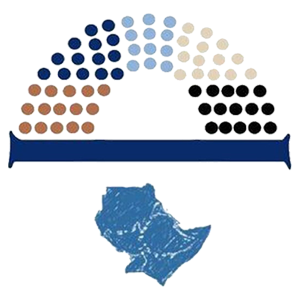
The IGAD Knowledge and Research programme provides evidence-based analysis on the Intergovernmental Authority on Development — covering peace and security, IGAD–Gulf relations, climate resilience and natural resources, social and humanitarian affairs, and regional integration across the Horn of Africa.
BRIDGE's IGAD Knowledge and Research programme delivers evidence-based analysis on the Intergovernmental Authority on Development. The programme tracks five thematic streams: peace and security; IGAD member states and the Gulf; climate resilience and natural resources; social and humanitarian affairs; and regional integration. Outputs include a monthly digest, occasional papers, policy briefs, and the Resource Hub.
Conflict dynamics, early warning, preventive diplomacy, peacekeeping, maritime security, and counter-extremism in the IGAD region.
Stream 02The evolving relationship between IGAD member states and Gulf states — trade, security, migration, and diplomacy.
Stream 03Climate-related governance, transboundary water and resource management, and institutional adaptation in the Horn.
Stream 04Humanitarian concerns, social policy, displacement, and cross-border challenges within IGAD frameworks.
Stream 05Institutional cooperation, regional mechanisms, and practical pathways for policy alignment across IGAD member states.
RecurringA monthly publication tracking IGAD’s institutional work, summit decisions, and regional political developments.
Peace and security is the pivotal thematic area of BRIDGE’s IGAD work. The stream tracks regional stability and the policy and institutional architecture that addresses ongoing conflicts, early warning, preventive diplomacy, peacekeeping, maritime security, secure access to the sea, and violent extremism. Research outputs span the Sudan SAF–RSF conflict, the Ethiopia–Somalia tensions over the Somaliland Memorandum of Understanding, IGAD’s Conflict Early Warning and Response Mechanism (CEWARN), and the Red Sea security architecture.
The body of work feeds the IGAD Monthly Digest, occasional papers, and policy briefs — including the featured study IGAD: Dialogue and Mediation in Demand co-authored with the Institute for Peace and Security Studies (IPSS) and Friedrich-Ebert-Stiftung.
Sudan’s SAF/RSF conflict, the Ethiopia–Somalia tensions over the Somaliland MoU, and broader Horn of Africa flashpoints.
Preventive diplomacy, IGAD's early warning mechanisms, and mediation tracks across the region.
Maritime security, secure access to the sea, and counter-extremism strategies relevant to IGAD member states.
The evolving relationship between IGAD member states and the Gulf is a defining feature of contemporary regional politics. Port concessions, agricultural investment, labour mobility, military basing, and crisis diplomacy now run through Gulf capitals as much as through African ones. BRIDGE follows the diplomatic, economic, and security dimensions of this relationship and how it reshapes the Horn of Africa.
Coverage tracks bilateral and multilateral engagements between Saudi Arabia, the UAE, Qatar, and Egypt on one side and Ethiopia, Sudan, Somalia, South Sudan, Djibouti, Eritrea, Kenya, and Uganda on the other — including the Red Sea Council, migration corridors, port and infrastructure deals, and the security implications of competing alignments.
Investment flows, port concessions, infrastructure agreements, and the political ramifications of Gulf states' growing economic footprint in the IGAD region.
Migration corridors, labour-mobility agreements, security cooperation, and the broader Red Sea security architecture.
Climate-related governance, resilience policy, transboundary water and resource management, and institutional adaptation form a growing area of BRIDGE’s IGAD research. The Horn of Africa is one of the world’s most climate-exposed regions, and IGAD’s climate work — through the IGAD Climate Prediction and Applications Centre (ICPAC) and the IGAD Drought Disaster Resilience and Sustainability Initiative (IDDRSI) — sits at the centre of regional adaptation policy.
BRIDGE tracks climate finance, green-investment commitments, transboundary water governance along the Nile and Juba–Shabelle basins, pastoralist resilience, and the political economy of energy transition across IGAD member states. The stream connects directly to Ethiopia’s role as host of COP 32 in Addis Ababa in November 2027.
This stream connects directly to Ethiopia's role as host of COP 32. BRIDGE's Climate Resilience & Natural Resources research will track climate finance, green-investment commitments, transboundary water governance, and institutional adaptation across the IGAD region in the run-up to and following the summit.
The IGAD region hosts one of the largest displaced populations on the continent — refugees from Sudan, South Sudan, and Somalia, internal displacement linked to conflict and drought, and significant labour migration to the Gulf. Social and humanitarian affairs at BRIDGE examines how IGAD frameworks, national authorities, and humanitarian partners coordinate response, protection, and longer-term integration.
The stream covers refugee policy and IGAD’s implementation of the Global Compact on Refugees, cross-border pastoralist and transhumance governance, health and education coordination, social protection, and the humanitarian–development–peace nexus. BRIDGE outputs feed into the IGAD Monthly Digest and inform briefings to regional and international partners.
Refugee flows, internal displacement, and policy responses across IGAD member states.
Health, education, and social-protection coordination within IGAD frameworks.
Pastoralism, transhumance, and shared-border governance across the IGAD region.
Regional integration tracks institutional cooperation, the legal architecture of IGAD itself, and practical pathways for policy alignment across member states. The June 2023 New Treaty broadened IGAD’s cooperation mandate to tourism, digital governance, gender, and private-sector engagement — reshaping how the secretariat operates and how member states relate to it.
BRIDGE’s analytical line on this stream is anchored by two occasional papers: the first traces IGAD from its 1986 establishment as IGADD through the 1996 revitalisation to the New Treaty, and the second analyses Eritrea’s formal withdrawal on 12 December 2025 and its implications for institutional cohesion and the regional integration agenda.
Traces IGAD from its 1986 establishment as IGADD through the 1996 revitalisation to the June 2023 New Treaty broadening cooperation across tourism, digital governance, gender, and the private sector.
Occasional Paper No. 002Analyses Eritrea's formal withdrawal on 12 December 2025 and its implications for IGAD's institutional cohesion and regional integration agenda.
A monthly publication summarising IGAD's institutional work, summit decisions, and regional political developments. Issues are published as developments warrant and are available alongside the Enderasie Monthly Digest in the Publications section.
Inaugural issue covering IGAD secretariat activity and member-state political developments.
Coverage of summit preparations, secretariat communiqués, and bilateral developments among IGAD member states.
Coverage of IGAD's institutional work and member-state political developments through the issue period.
February edition. Highlights IGAD's prominent role at the African Union Summit and notes Sudan's return as a decisive step for regional engagement.
A featured study tracking Africa's peace through a regional lens. Authored by Dr. Mercy Fekadu and Dr. Kaleab Tadesse, published by IPSS at Addis Ababa University with Friedrich-Ebert-Stiftung. The study examines the rising demand for dialogue and mediation in the IGAD region during late 2023 and early 2024 — including Sudan's SAF/RSF conflict and Ethiopia–Somalia tensions over the Somaliland MoU.
Authors: Dr. Mercy Fekadu · Dr. Kaleab Tadesse.
Publishers: Institute for Peace and Security Studies (IPSS), Addis Ababa University · with Friedrich-Ebert-Stiftung.
The study examines the rising demand for dialogue and mediation in the IGAD region during late 2023 and early 2024. Cases analysed include the Sudan SAF/RSF conflict and the Ethiopia–Somalia tensions surrounding the Somaliland Memorandum of Understanding. The piece is part of an ongoing RECs Spotlight series tracking Africa's peace through a regional-economic-communities lens.
The IGAD region is increasingly being asked to convene mediation tracks even as its institutional capacity is stretched. The study examines how IGAD, the AU, and partner institutions can respond.
A reference map of the IGAD region and its eight member states, alongside the BRIDGE library of IGAD-related digests, occasional papers, policy briefs, and handbooks.
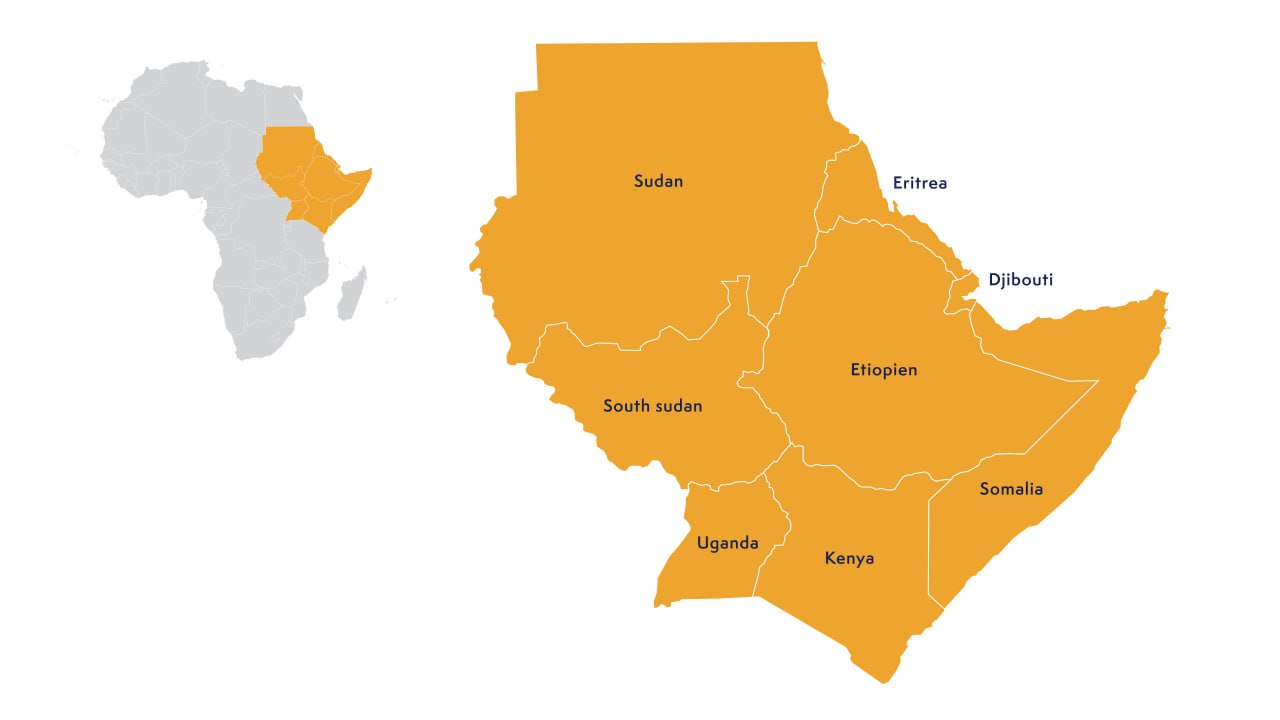
A reference map of the Intergovernmental Authority on Development covering its member states across the Horn of Africa.