Decided at COP30 in Belém
The decision was finalized and officially announced during the closing plenary of COP30 in Belém, Brazil in November 2025.
Ethiopia has been officially selected to host the 32nd United Nations Climate Change Conference (COP32) in Addis Ababa in November 2027. This page is BRIDGE’s publications hub for COP32 — gathering briefings, digests, and research outputs on Ethiopia’s COP32 Presidency.
A concise summary of the official decisions, leadership, and themes shaping Ethiopia’s preparations to host the 32nd United Nations Climate Change Conference.
The decision was finalized and officially announced during the closing plenary of COP30 in Belém, Brazil in November 2025.
Ethiopia’s Minister of Foreign Affairs, Dr. Gedion Timotheos, has been appointed as the COP32 President-Designate.
The summit is expected to highlight African climate priorities, including climate finance, green investment, and sustainability education.
Ethiopia’s selection was supported by the African Group of Negotiators, citing its leadership in green initiatives like the Green Legacy Initiative and its extensive use of renewable energy, specifically the Great Ethiopian Renaissance Dam (GERD).
The event is anticipated to attract approximately 50,000 participants, including world leaders and climate stakeholders. This will be one of the largest international convenings hosted in Addis Ababa to date.
Ethiopia has been officially selected to host the 32nd United Nations Climate Change Conference (COP32), which is scheduled to takeplace in Addis Ababa in November 2027.
Key Details of COP32 in Ethiopia.
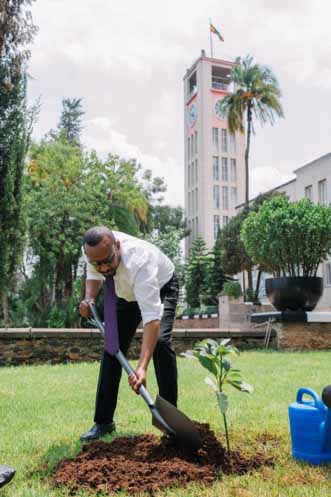
Launched in 2019 by Prime Minister Dr. Abiy Ahmed, the Green Legacy Initiative (GLI) is an ambitious national tree-planting and environmental restoration campaign designed to combat severe deforestation, land degradation, and the impacts of climate change in Ethiopia.
The overarching goal of the multi-phase program is to plant a cumulative total of 65 billion seedlings nationwide. The current 2026 campaign targets the planting of 8 billion seedlings during the rainy season, keeping the country on track toward its long-term national sustainability benchmarks.
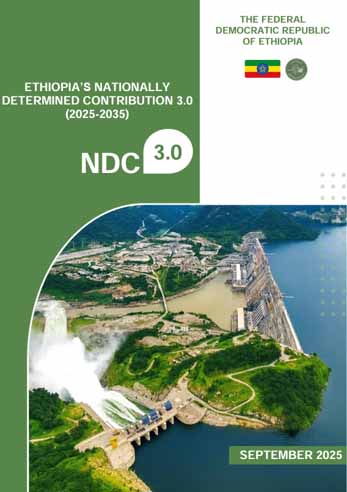
Ethiopia’s Nationally Determined Contribution (NDC 3.0) for 2025–2035 establishes a comprehensive roadmap for climate-resilient growth, aligning near-term actions with a net-zero emissions vision for 2050. The strategy is deeply integrated with the country’s Ten-Year Development Plan and emphasizes a transition toward a green economy driven by the Green Legacy Initiative, renewable energy expansion, and a pioneering shift toward electric mobility. By clearly disaggregating unconditional domestic commitments from conditional targets that require international partnership, Ethiopia aims to enhance transparency and attract the necessary climate finance to protect its agriculture, energy, and urban sectors from escalating climate shocks. A revitalized governance framework, led by the Ministry of Planning and Development, ensures that these climate objectives are harmonized with national development priorities and supported by robust monitoring and reporting systems.
A REDD+ strategy is a national or sub-national framework developed by countries under the United Nations Framework Convention on Climate Change (UNFCCC) to reduce greenhouse gas emissions from deforestation and forest degradation while promoting sustainable forest management, forest conservation, and the enhancement of forest carbon stocks.
REDD+ stands for "Reducing Emissions from Deforestation and Forest Degradation in Developing Countries." The plus (+) represents additional activities such as forest conservation, sustainable forest management, and increasing forest carbon stocks.
Ethiopia’s National REDD+ Strategy (2018–2030) provides a comprehensive framework to help the country achieve its target of net zero emissions by 2030 through intensive forest resource and land management. The strategy identifies the forest sector as a primary pillar of the national green economy, responsible for half of all planned emission reductions by addressing direct drivers of forest loss such as agricultural expansion, unsustainable fuelwood extraction, and forest fires. By integrating efforts across the forestry, energy, and agricultural sectors, the strategy aims to restore millions of hectares of degraded landscapes, scale up Participatory Forest Management (PFM), and promote energy-efficient technologies to enhance both ecosystem resilience and rural livelihoods.


Ethiopia assumes the COP32 Presidency at a moment when African states are pressing for delivery on climate finance, adaptation, and equitable green transition. Dr. Gedion Timotheos, Minister of Foreign Affairs, leads preparations as President-Designate, supported by national institutions and the African Group of Negotiators.
The African Group of Negotiators backed Ethiopia’s candidacy in recognition of the country’s sustained green-policy work, including the Green Legacy Initiative and its expansive renewable-energy programme anchored by the Great Ethiopian Renaissance Dam (GERD).
Beyond the formal negotiating tracks, Ethiopia’s presidency is expected to centre climate finance, green investment, and sustainability education — framing the summit as both a negotiating moment and a continental learning convening.
COP32 sits in BRIDGE’s publications stream — not its training catalogue. Briefings, monthly digests, and research outputs covering Ethiopia’s COP32 Presidency are collected on the Publications page and surfaced through the regular digest cycle.
All COP32 briefings, policy notes, and research outputs are catalogued on the BRIDGE Publications page. Follow publications.html#cop32 for the running list.
Monthly DigestCOP32-relevant items appear in the Enderasie Monthly Digest and the IGAD Monthly Digest in the run-up to and during the November 2027 conference.
Connected ResearchContinued analysis through BRIDGE’s IGAD Climate Resilience & Natural Resources stream, examining how Ethiopia and the Horn’s climate priorities translate into legislative and policy outcomes.
Researchers, parliamentarians, and partner institutions interested in collaborating on COP32-related research, publications, or briefings can write to info@bridge-et.org.